What is MG?
gMG is a rare, chronic autoimmune neuromuscular disease of the NMJ, that may result in chronic impaired muscle function1-4
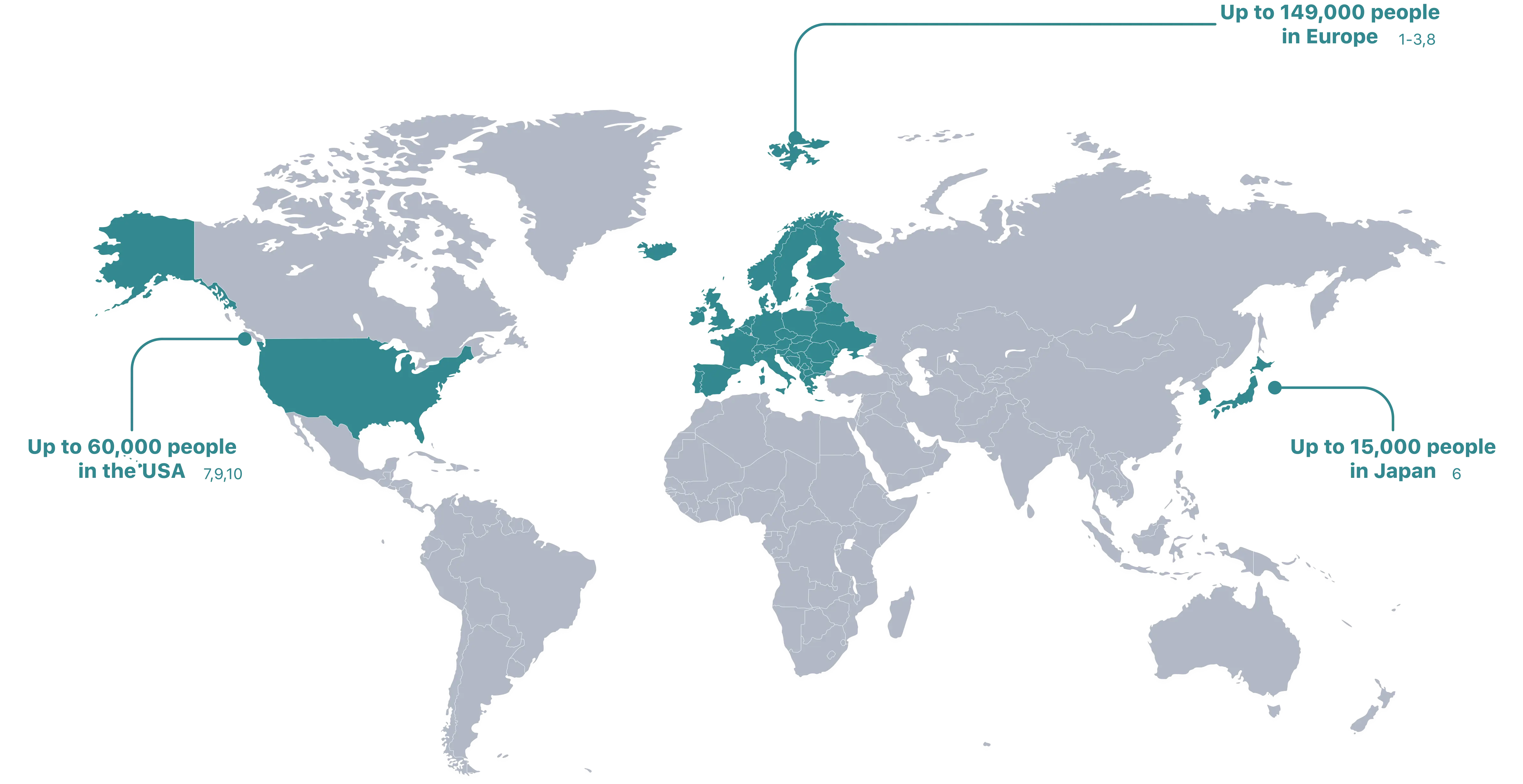
Prevalence and incidence of MG
The worldwide prevalence of MG is estimated to be between 80 and 278 per million 5-11

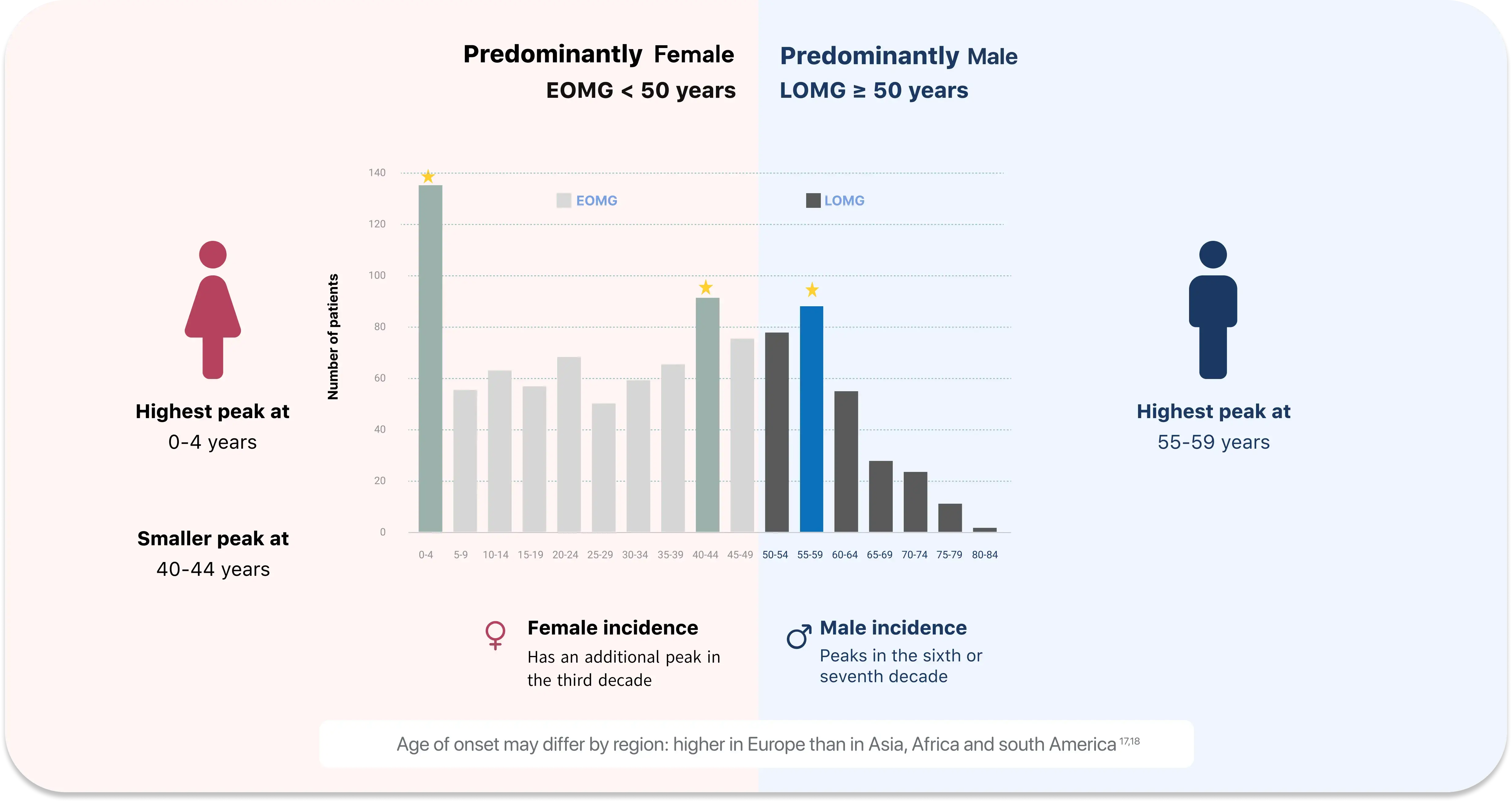
Age at MG onset differs between
Women & Men16
Manifestation of MG


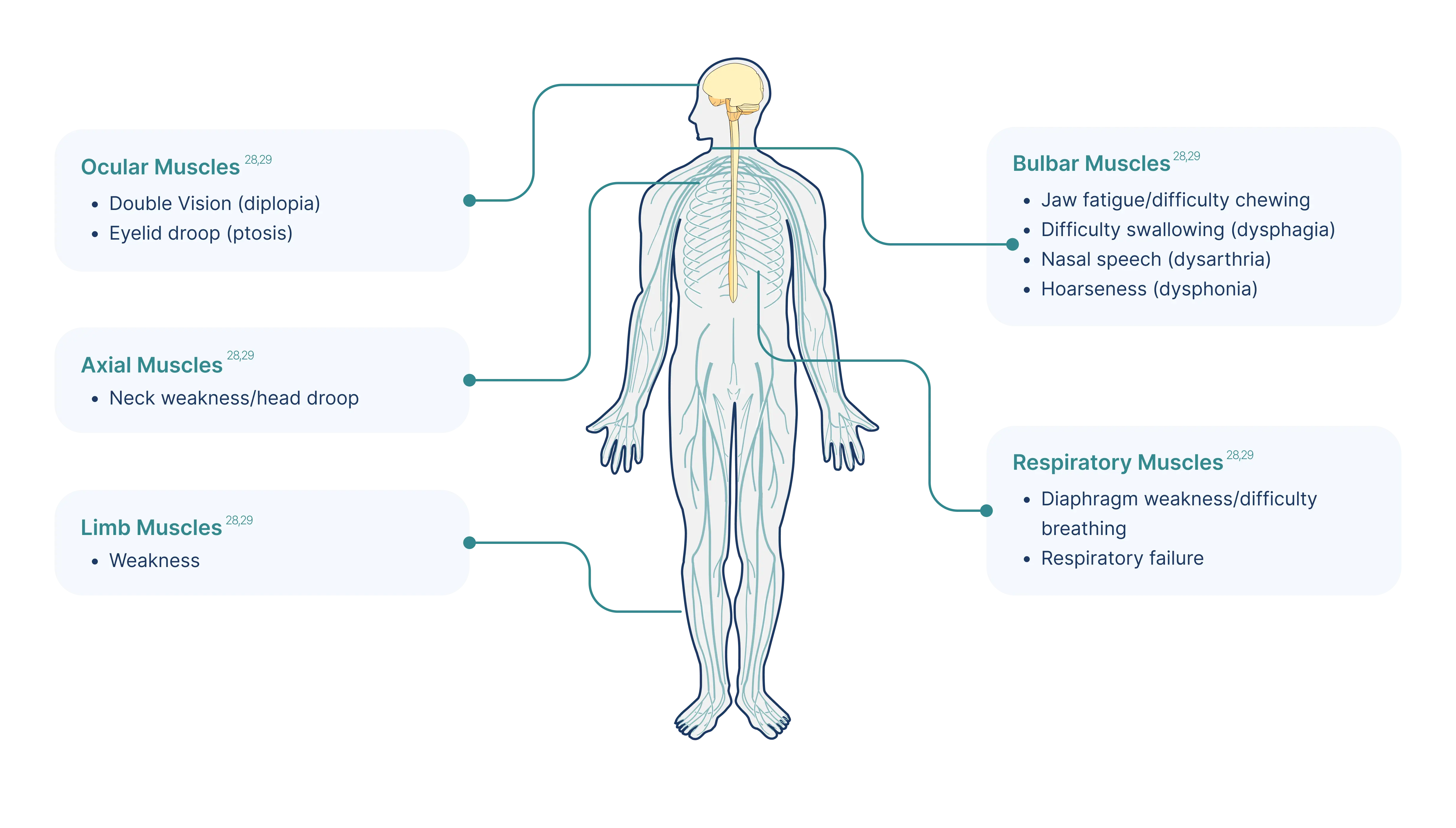

Characterized by fluctuating and fatigable muscle weakness,often in the ocular muscles 1,2

In ~80%of patients, the disease generalizes
(gMG)to affect other muscles 21,22
aBased on a comprehensive survey in England to establish epidemiological data to examine patterns of clinical practice and disease phenotype from 100 cases of MG
bBased on a retrospective study of 1976 patients with MG between 1940 and 2000
Unpredictable gMG symptom fluctuations lead to a profound burden27,28
96% experienced symptom fluctuations27a In concept elicitation interviews conducted in 28 adult patients with gMG.
Fluctuations occur consistently and have a serious impact on QoL27,28a

Despite conventional therapy, 2 out of 3 patients experience gMG symptoms7b
Uncontrolled gMG can ultimately lead to clinical events such as life-threatening crises or exacerbations8
Fluctuations occur consistently and have a serious impact on QoL27,28a
aResults from qualitative, cross-sectional, non-interventional study having semi-structured, in-depth concept elicitation interviews (N=28) conducted in the US with adult patients diagnosed with gMG.27
bResults of a questionnaire sent to 3262 members of the German Myasthenia Association who had myasthenia gravis (MG) (response rate of 52.5% [n=1660]) that reported various aspects of respondents' lives, including demographic data, educational status, employment, income, and level of disability.29
cInsights based on qualitative data collected from a global, qualitative research study of 54 people affected by MG, a patient council report on six people living with MG, and a literature review of patient-reported outcomes.28



Vision problems in gMG are common and may impact QoL27,31
These issues can have a negative impact on activities of daily living, such as working or driving27
Patients rate vision problems as one of the top 2 most burdensome gMG symptoms27,31
~85% of patients with gMG experience ocular muscle weakness, which can be progressive31
- Resultant double vision and ptosis can impact quality of life27,31
- 54%-79% of patients with gMG (n=22/28, n=245/452, respectively) report double vision27,32a,b
- aResults from a questionnaire-based, qualitative, cross-sectional, non-interventional survey (N=452) conducted in Japan in patients 15 years of age and older with MG who were receiving regular outpatient treatment.32
- bResults from qualitative, cross-sectional, non-interventional study having semi-structured, in-depth concept elicitation interviews (N=28) conducted in the US with adult patients diagnosed with gMG.27
gMG exacerbation and myasthenic crisis
- Generally defined as significant worsening of gMG symptoms
- Typically requires inpatient treatment
- The most severe type of gMG exacerbation is myasthenic crisis
- Severe weakness in respiratory muscles, leading to respiratory failure and requiring intubation and mechanical ventilation
Certain factors are associated with worsening of symptoms and with a high risk of exacerbations25,33-35

Late onset of disease

Autoimmune comorbidities

Hot weather

Infection

Emotional stress

Certain drugs, including fluoroquinolone, macrolides and amino glycosides
gMG crises
- Are more common on the first 2 years following disease 36,37
- Can cause acute symptoms that impact daily life36,38,39
- Can lead to hospitalization, mechanical ventilation, tube feeding, and death31,40
of patients may experience MG-related hospitalizations, most striking within the first 2-3 years of disease onset. 41*
*This retrospective longitudinal cohort study evaluated 1149 adult patients with gMG living in England using data recorded from 1997 to 2016. 41
of hospital stays were followed by discharge to a skilled nursing or longterm acute-care facility. 42
**Hospitalized and treated between 2010 and 2019 in USA
Burden of gMG impact multiple aspects of individuals' lives27a

Emotional impact
- Anxiety (82%)
- Depression/sadness (75%)
- Frustration (64%)
- Fear (57%)
- Embarrassment (54%)

Social impact
- Dating/partner (57%)
- Feeling misunderstood (46%)

Physical impact
- Gross motor impairment (93%)
- Hobbies and sports (89%)
- IADLsᵇ (82%)
- ADLsᶜ (57%)
- Fine motor impairment (46%)

Other life domains
- Impact on work/career (100%)
- Need for increased planning (89%)
- Sleep disturbances (89%)
- Needing assistance (64%)
- aBased on a qualitative, cross-sectional, noninterventional study involving interviews with 28 adult patients with gMG in the United States.
- bIADLs are activities with aspects of cognitive and social functioning that are necessary for independent functioning in the community such as shopping, cooking, housework, and managing finances.
- cADLs are basic self-care activities such as bathing, dressing, grooming, eating, and using the bathroom. ADL, activity of daily living; gMG, generalised myasthenia gravis; IADL, instrumental activity of daily living.
gMG, generalized myasthenia gravis; NMJ, neuromuscular junction, Qol, quality of life
References:
- 1. Conti-Fine BM et al. J Clin Invest 2006;116:2843-54.
- 2. Mantegazza R et al. Neuropsychiatr Dis Treat 2011;7:151-60.
- 3. Thanvi BR et al. Postgrad Med J 2004;80:690-700.
- 4. Juel VC et al. Orphanet J Rare Dis 2007;2:44.
- 5. Heldal AT et al. Neurology 2009;73:150-1.
- 6. Cetin H et al. Wien Klin Wochenschr 2012;124:763-8.
- 7. Fang F et al. J Intern Med 2015;277:594-604.
- 8. Park SY et al. J Clin Neurol 2016;12:340-4.
- 9. Carr AS et al. BMC Neurol 2010;10:46.
- 10. Murai H et al. J Neurol Sci 2011;305:97-102.
- 11. Phillips LH, 2nd. Ann N Y Acad Sci 2003;998:407-12.
- 12. Orphanet. Myasthenia gravis. Available from: orpha.net (Accessed Feb 2026).
- 13. Myasthenia Gravis Foundation of America. Clinical overview of MG. Available from: https://myasthenia.org/Professionals/Clinical-Overview-of-MG (Accessed Feb 2026).
- 14. Chen J et al. Lancet Reg Health West Pac 2020;5:100063.
- 15. Conquer Myasthenia Gravis. Men's & women's issues and myasthenia gravis. Available from: https://www.myastheniagravis.org/mens-womens-issues-myasthenia-gravis/ (Accessed Feb 2026).
- 16. Fan L, et al. Neurological Res. 2019; 41:45-51.
- 17. Alanazy MH. Neurosciences 2019; 24:176-84.
- 18. Santos E, et al. Muscle Nerve 2016; 54: 413-21.
- 19. Anderson JB, et al. Eur Journal Neurology 2010; 17:1445-50.
- 20. Asmail A, et al. Int J Neurosci 2019; 129:313-9.
- 21. Grob D, et al. Muscle Nerve 2008; 37: 141-9.
- 22. Robertson NP et al. J Neurol Neurosurg Psychiatry 1998;65:492-6.
- 23. Melzer N et al. J Neurol 2016;263:1473-94.
- 24. Zieda A et al. Eur J Neurol 2018;25:519-26.
- 25. Meriggioli MN et al. Lancet Neurol 2009;8:475-90.
- 26. Li Y et al. Cleve Clin J Med 2013;80:711-21.
- 27. Jackson K, Parthan A, Lauher-Charest M, Broderick L, Law N, Barnett C. Neurol Ther. 2023;12(1):107-128.
- 28. Law N, Davio K, Blunck M, Lobban D, Seddik K. Neurol Ther. 2021;10(2):1103-1125.
- 29. Lehnerer S, Jacobi J, Schilling R, et al. J Neurol. 2022;269(6):3050-3063.
- 30. Howard JF, Vu T, Mantegazza R, et al. Muscle Nerve. 2024;69(5):556-565.
- 31. Jayam Trouth A, Dabi A, Solieman N, Kurukumbi M, Kalyanam J. Autoimmune Dis. 2012;2012:874680.
- 32. Kawaguchi N, Tsuda K, Tanaka N, Kerstens R, Harada D. Neurol Ther. 2024;13(4):1099-1113.
- 33. Schroeter M et al. Neurology International Open 2018;2:E10-5.
- 34. de Meel RHP et al. J Neuroimmunol 2015;282:123-5.
- 35. Gilhus NE et al. Eur J Neurol 2015;22:17-23.
- 36. Kalita J, Kohat AK, Misra UK. Neurol Sci. 2014;35(7):1109-1114.
- 37. Wendell LC, Levine JM. Neurohospitalist. 2011;1(1):16-22.
- 38. Claytor B, Cho SM, Li Y. Muscle Nerve. 2023;68(1):8-19.
- 39. Mück A, Pfeuffer S, Mir L, et al. J Neurol. 2024;271(8):5650-5655.
- 40. Wang Y, Huan X, Zhu X, et al. Ther Adv Neurol Disord. 2024;17:17562864241226745.
- 41. Harris L, Graham S, MacLachlan S, Exuzides A, Jacob S. BMC Neurol. 2022;22(1):172.
- 42. Ramsaroop T, Gelinas D, Kang SA, Govindarajan R. BMC Neurol. 2023;23(1):12.